October 12th Research Briefing
Contents
- ToFu: fuzzing finds 253 verified bugs in MCP agent tools
- QuSema: quantum-library agent confirms 40 silent and crash bugs
- REINS: agent-guided scheduling finds six Mozilla concurrency bugs
ToFu: fuzzing finds 253 verified bugs in MCP agent tools
ToFu found 253 hand-verified semantic security bugs across 343 tools in 118 of 273 open-source Model Context Protocol (MCP) servers (3405 tools total). The bugs span path traversal, log injection, reflected output, SSRF, OS command injection, and related classes. Each finding came from schema-valid fuzz inputs that violate the semantics the tool's own metadata advertises.
This matters because agent frameworks treat LLM-generated tool arguments as structured calls and often trust them once the orchestrator accepts the schema. If the tool does not enforce what its description claims (path containment, URL allowlists, command separation), the orchestrator becomes a trust boundary that silently fails.
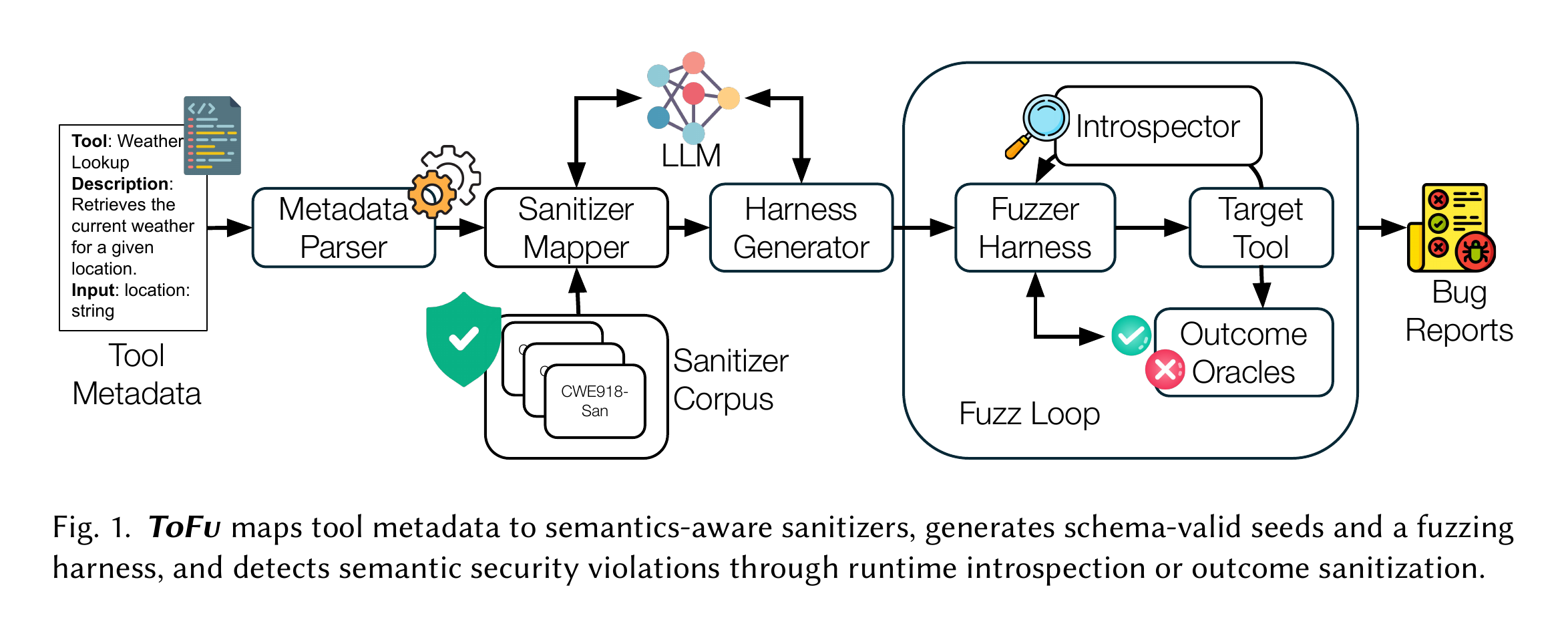
ToFu parses tool metadata, maps arguments to checks from a CWE-guided sanitizer corpus, and has an LLM specialize those checks per tool. It then builds an Atheris harness that mutates only schema-valid values. Runtime introspection watches filesystem, process, and network effects, and outcome oracles flag accepted adversarial inputs.
At a 60 second budget per tool, ToFu recovers 231 of the 253 verified bugs. Removing the LLM mapper still finds about two thirds of the bugs at zero LLM cost, while LLM seeds mainly add reach into harder classes. The result is a measured failure mode for MCP tool ecosystems: documented input semantics are not a substitute for enforcement.
Authors: Md Nazmul Islam Ananto, Pierre Prevost-Avenel, Colin Smith, Kyungtae Kim, Taegyu Kim, and Arslan Khan (paper, pdf). Kyungtae Kim: GitHub. Taegyu Kim: GitHub, LinkedIn. Arslan Khan: GitHub, LinkedIn.
QuSema: quantum-library agent confirms 40 silent and crash bugs
QuSema found 40 previously unknown bugs in Qiskit 2.4.1 and PennyLane 0.45.0. Maintainers confirmed all 40. Thirty are silent bugs: valid inputs produce invalid outputs without a crash or runtime check failure. Five of those silent bugs sit in functionality with no comparable API or circuit transformation in the other library, so differential and metamorphic oracles cannot catch them.
This matters because quantum libraries feed experiments, simulations, and algorithm design. A silent bug can corrupt results without leaving an obvious failure signal, and black-box oracles only fire when executions disagree or crash.
QuSema builds contextual units from code segments, call relations, and documentation. An agent compares implementation logic against quantum semantics and library docs, forms a defect hypothesis, and tries to trigger it. A second stage searches for a documented library API that reaches the defect, then qualifies the case as bug, potential bug, or not a bug.
On a 20-bug historical silent-bug benchmark, QuSema relocates more defects than Claude Code and Codex, and a DeepSeek configuration costs less than Claude Code. The new bugs cover circuit transformation, symbolic operators, commutativity, measurement, resource estimation, serialization, and execution.
Authors: Yujin Song, Kaining Zhang, Qixin Zhang, Shuai Wang, Pingchuan Ma, and Yuxuan Du (paper, pdf). Pingchuan Ma: GitHub. Yuxuan Du: GitHub.
REINS: agent-guided scheduling finds six Mozilla concurrency bugs
REINS found six previously unknown concurrency bugs in Mozilla NSPR and SpiderMonkey. The three SpiderMonkey bugs (GC and Wasm) were confirmed and fixed by core developers. On SCTBench, ConVul, and RaceBench, REINS also detects more injected and known concurrency bugs than prior controlled concurrency testing under the same time budget, including 38 more RaceBench bugs than the best baseline.
This matters because concurrency bugs appear only under rare interleavings. Random or lightly guided schedulers spend their budget on irrelevant orders, while the semantic conditions that make a bug real (which shared variables, which access sites, which event order) sit in the program itself.
REINS runs an LLM agent in Comprehend, Attempt, and Assess rounds. It combines runtime observations with static information, proposes a bug hypothesis, and turns that hypothesis into constraints on event order and variable state. A controlled scheduler steers threads toward those constraints. Execution results refine or refute the hypothesis until the bug triggers or the budget ends.
The motivating SpiderMonkey case is an atomicity violation where a cached CodeExists flag and a code-block map can diverge for one statement, skipping a bounds check and crashing on out-of-bounds access. REINS is built to aim the scheduler at that kind of short, semantic window.
Authors: Yu Zhang, Corina S. Pasareanu, and Guowei Yang (paper, pdf). Corina S. Pasareanu: GitHub. Guowei Yang: GitHub, LinkedIn.